

Industrial facilities continue to expand in both size and complexity. Manufacturing plants, warehouses, tank farms, data centers, and logistics hubs require reliable fire protection systems. Recent industry searches increasingly focus on fire pump sizing, hydrant network calculation, and fire water reservoir capacity.
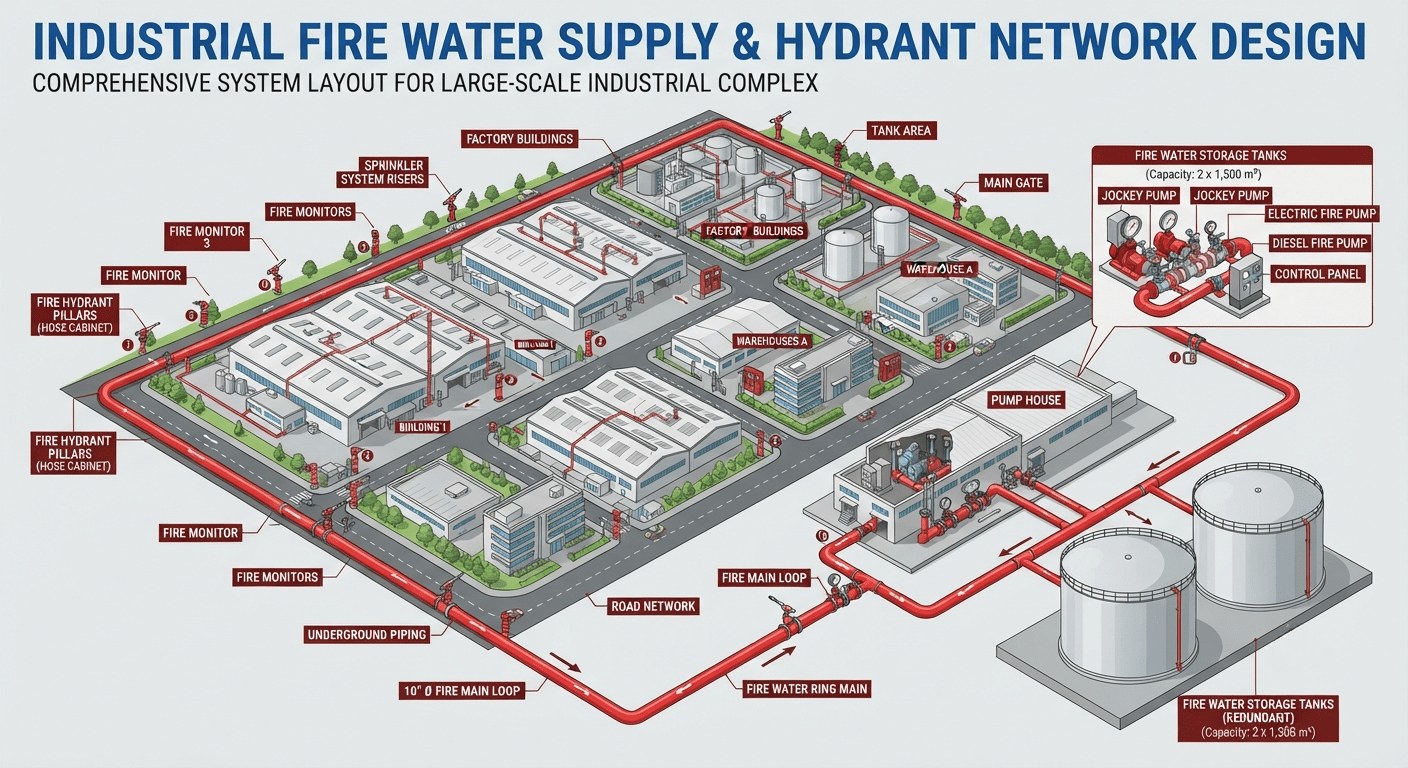
Fire Water Supply & Hydrant Network Design provides the foundation for delivering adequate water throughout an industrial facility during emergencies. A properly designed system maintains sufficient pressure at every hydrant, including the most remote locations.
Poor system design often causes pressure drops when multiple hydrants operate simultaneously. This situation can delay firefighting efforts during the most critical moments.
Determining Fire Water Reservoir Capacity
The fire water reservoir serves as the dedicated water source for firefighting operations. Its capacity must satisfy the required water demand throughout the specified firefighting duration.
Engineers evaluate several important factors.
- Total facility size.
- Fire hazard classification.
- Number of operating hydrants.
- Sprinkler system demand.
- Water supply duration.
- NFPA and local regulatory requirements.
High-risk industrial facilities generally require larger reservoirs than standard warehouses. Sites storing flammable materials also need additional water reserves.
The fire water reservoir should remain independent from domestic and process water systems. This approach guarantees water availability during operational disruptions.
Calculating Fire Pump Capacity
The fire pump acts as the heart of the hydrant network. It must deliver the required flow rate and pressure across the entire system.
Key design parameters include:
- Total flow requirement.
- Static head.
- Pipe friction loss.
- Elevation difference.
- Safety margin.
Complete hydraulic calculations are essential. Undersized piping increases friction loss and reduces pressure at remote hydrants.
Engineers should also consider future facility expansion when selecting fire pumps. Proper planning minimizes future upgrade costs.
Optimizing Hydrant Network Performance
A hydrant network should distribute water evenly throughout the industrial site.
Loop systems often provide higher reliability than dead-end systems. Water continues flowing through alternate routes if one pipeline becomes unavailable.
Engineering teams frequently perform hydraulic modeling using specialized software. These simulations verify pressure levels under emergency operating conditions.
Digital modeling improves design accuracy while reducing installation risks.
Following International Standards
Fire protection systems should comply with internationally recognized standards.
Common references include NFPA 20 for fire pumps, NFPA 22 for water tanks, NFPA 24 for underground fire service mains, and NFPA 14 for standpipe and hose systems.
Compliance improves system reliability while protecting valuable industrial assets.
Routine inspection and maintenance also ensure pumps, hydrants, valves, and reservoirs continue performing as designed.
Fire protection investments provide more than regulatory compliance. They protect personnel, facilities, and business continuity.
With proper Fire Water Supply & Hydrant Network Design, companies can accurately determine pump capacity, reservoir size, and hydrant network performance. The result is a dependable fire protection system ready for emergency situations.
PT ODG Indonesia delivers complete fire protection solutions, including engineering, system design, installation, testing, commissioning, and maintenance for industrial, mining, oil & gas, data center, and infrastructure projects. Contact PT ODG Indonesia to develop a Fire Water Supply and Hydrant Network that complies with international standards and supports your operational reliability.
Whatsapp : marketing@ptodg.com
Email : +62 811 1302 0888